Stashes and unlock rules
Core data and UI patterns support personal, friend, and community capsules with delayed reveal logic.
A social time-capsule product now available on the App Store: capture memories now, lock them by design, and revisit them later when the moment matters.
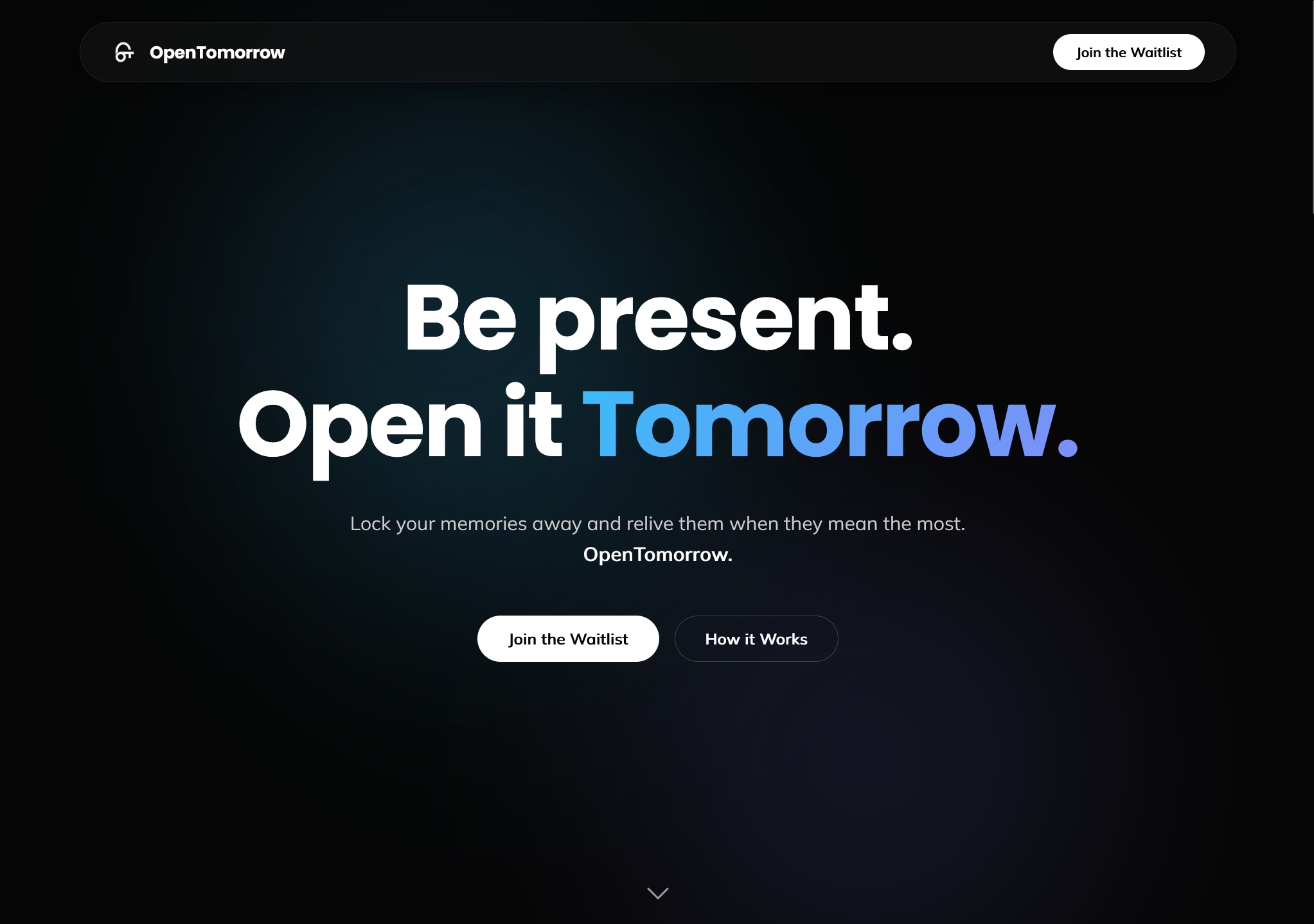
Visit opentomorrow.app · Download on the App Store
OpenTomorrow is built around one product bet: delayed gratification can feel more meaningful than instant feed consumption. Instead of posting and scrolling immediately, users create stashes, add media, and open those memories later on intentional timelines.
The product launched on the App Store after a closed beta cycle, with an Expo mobile app, a Next.js marketing surface, and Supabase-backed auth/data. Development is part of my senior thesis in Design and Creative Technology.
Most social products optimize for instant reaction loops. In practice, that means users get ads, algorithmic noise, and low signal from people they actually care about. The core problem OpenTomorrow addresses is emotional, not just technical: preserving moments without forcing immediate performance.
The challenge was turning that value proposition into a usable product model that still feels social. Users need clear rules for when content unlocks, who sees it, and how shared memories stay trustworthy over time.
Three stash modes anchor the product, each mapped to a distinct use case and social context.
A private vault for reflection: lock monthly check-ins, yearly reviews, or whole chapters of life and open them on your schedule.
Groups contribute media to one timeline—trips, weddings, nights out—so everyone’s perspective lands in a single place when the stash unlocks.
Community stashes extend that idea to shared events—concerts, festivals, city moments—where people opt in to a collective capsule.
These screens show the core product flow: discovery feeds with locked timelines, stash creation with unlock controls, and profile-level stash management.
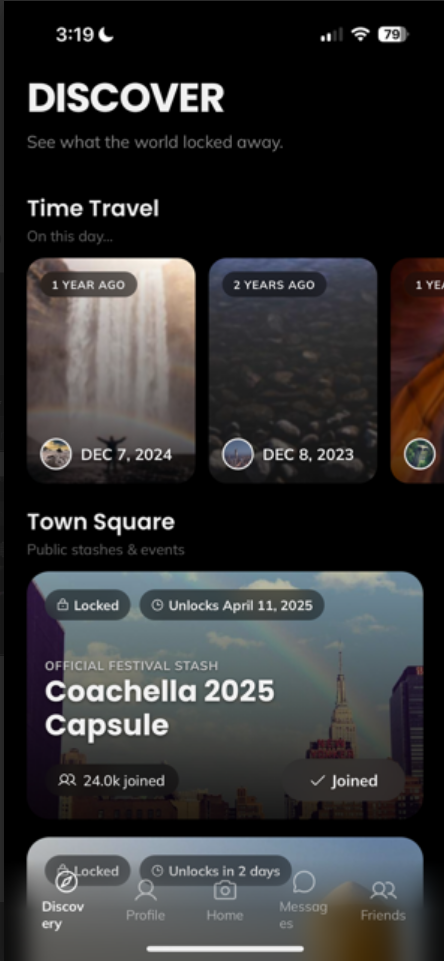
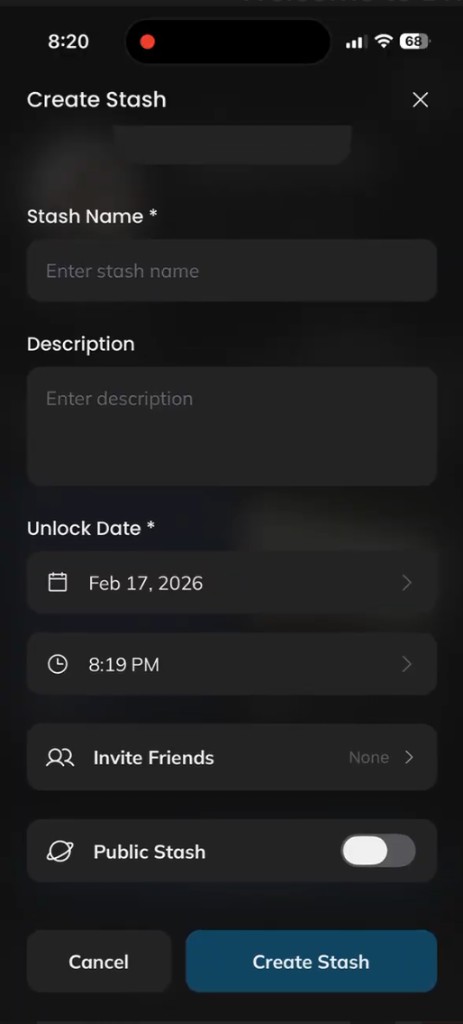
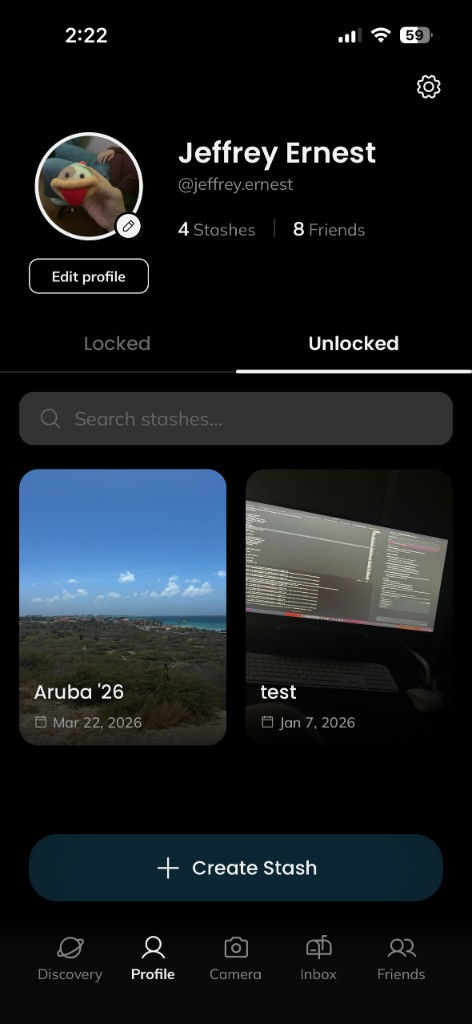
Product decisions were driven by one consistency check: does this feature help people stay present now and reconnect later? That framing influenced capture flows, stash creation, unlock settings, and messaging throughout onboarding and social surfaces.
UX research artifacts from thesis work informed prioritization and flow clarity before implementation.
Core data and UI patterns support personal, friend, and community capsules with delayed reveal logic.
Mobile-first photo/video flows route content into the right stash mode without breaking context.
Backend design prioritizes abuse prevention and stable usage patterns as public usage grows.
Supabase auth and policy-based access control keep private content and group boundaries predictable.
Next.js marketing and Expo app share one narrative: capture now, open later.
Used an AI-assisted workflow to accelerate iteration while validating every product and technical decision.
The Expo app handles core product interactions (capture, stash creation, social flows), while Next.js handles public storytelling and acquisition. Supabase is the source of truth for auth and structured data.
Architecture choices were guided by solo maintainability: keep one consistent data model, enforce secure access boundaries early, and design for stable scaling before broad release.
Brand identity was also built in-house: the OpenTomorrow mark was designed from scratch in Adobe Illustrator and then carried consistently across web and app surfaces.

OpenTomorrow moved from thesis concept to shipped iOS product and is now available to download on the App Store. The launch marked the transition from beta validation into a public product with real distribution, versioned updates, and a live marketing surface.
I shared the App Store launch on LinkedIn as a milestone for the project: taking OpenTomorrow from a thesis idea, through product design and engineering, into a public mobile release.
This project started outside my existing comfort zone and became a practical test of learning velocity. The biggest takeaway has been balancing quality with momentum: ship real features, keep product clarity high, and improve the system continuously as skills deepen.
Video analysis pipeline: MediaPipe landmarks, beat detection, and graphs for conducting motion.
All projects