Two-stage warning model
Known domains trigger immediate caution; unknown domains run on-demand scanning with a confidence score.
HEYI (“Hey, AI!”) is a Chrome extension built in 24 hours at HackTCNJ 2026 to help shoppers judge whether ecommerce content may be AI-generated before they buy.

Get HEYI on the Chrome Web Store
The project started from a practical trust problem: AI-generated listings and product visuals are increasingly hard to spot, especially for less technical shoppers. The goal was to provide fast, understandable risk signals directly in browsing context rather than in a separate tool.
HEYI won Best Use of Gemini API at HackTCNJ 2026. I built the extension UI and API integration flow, while Isabel DiFabio trained and hosted the text classifier on Hugging Face. The final product connected scanning, confidence scoring, and domain memory into one clear user flow.
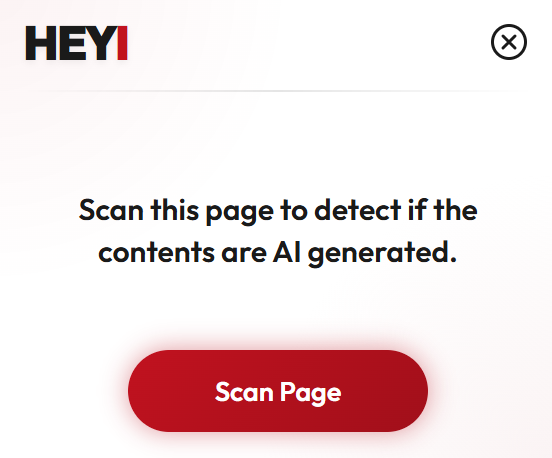
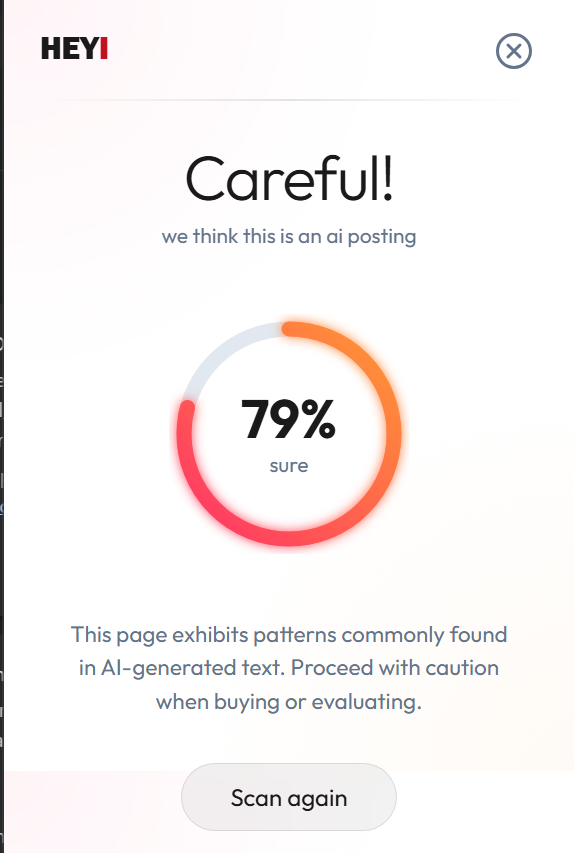
The extension works in two modes. If a domain has already been scanned and stored, users immediately get a proactive warning based on existing history. If not, they can trigger a fresh scan from the popup and receive a 0–100 confidence score indicating how likely the page content is AI-generated.
The score view is intentionally plain-language: a confidence number, short caution message, and a clear next action to scan again. The design choice was deliberate—under hackathon constraints, product clarity mattered more than adding extra technical controls.
Extension scripts collect page text and metadata, then call an Express backend for inference routing. The backend queries the Hugging Face-hosted text model and uses Gemini for complementary image signal. MongoDB stores domain-level history to support proactive warnings on future visits.
The hardest part was integration speed under a 24-hour deadline: extension, model endpoint, Gemini API, and persistence all had to stay reliable enough for a live judging demo.
Known domains trigger immediate caution; unknown domains run on-demand scanning with a confidence score.
Results are phrased as confidence guidance, not absolute verdicts, to avoid over-trusting model output.
Gemini, Hugging Face inference, and MongoDB were wired into one extension workflow fast enough for judging.
HEYI won Best Use of Gemini API at HackTCNJ 2026 and was later published to the Chrome Web Store. Judges responded strongly to its practical utility and clear communication model.
The project reinforced a key product lesson: ML ambition only matters if users understand the output quickly. Building HEYI improved how I integrate external APIs and how I communicate model confidence in a way that helps real-world decision making.
LinkedIn post from the hackathon launch and presentation.
Shared time-capsule product—Expo, Next.js, and Supabase for capture, social, and marketing.
All projects